Is There a Future Where AI Can Be Conscious?
Image credits: Kommers | Unsplash
Learning from the Diffs
This morning, I started my day the way I always do when I’m at home in California. I woke up (before my alarm, ugh) at the usual time. I meditated for 45 minutes. As I headed outside for a walk, I picked out a podcast to listen to. The episode was even one I had listened to before.
And yet, today, everything turned out differently from every other morning.
The conversation in the podcast—about Claude Shannon and the origins of information theory—wouldn’t quite settle in my mind. A passing comment suddenly seemed important. I could feel gravel beneath my sneakers and smell the earth that had been churned up near the soccer field. And a connection materialized where I hadn’t noticed one before.
Information Lies in the Difference

Image credits: Nisa Çokokumuş |Unsplash
Shannon famously showed that quantifying, storing, and communicating information is not just about the messages per se; it is about difference. (I am vastly oversimplifying here. Stay with me.) In communication systems, you don’t need to transmit everything. In fact, you rarely should. Efficient systems focus only on what changes (the “diffs”), which enables compression.
Think about digital video. These movies are not stored as millions of complete images. Instead, most frames are compressed by recording only the differences from the frame before. If the background hasn’t changed, then there is no reason to store it again. The system assumes a baseline and encodes the deviations.
That idea lingered with me as I walked.
Does the human brain operate along those lines? The answer seems to be yes.
For many—perhaps most—of us, daily life is largely predictable. Humans tend to move through familiar environments, repeat the same routines, and stay close to home. At the same time, the brain is constantly predicting what will happen next. When those predictions are accurate, there is not much new information to process. The brain can compress the experience heavily.
But when something truly novel happens—traveling somewhere new, meeting new people, encountering an unfamiliar idea—the brain has no baseline to compare against. There is a difference. There is information.
This may be part of why novel experiences feel so vivid and expansive in memory (although those memories aren’t necessarily more accurate). When you look back on a week spent exploring a new place, it feels full of new sounds, sights, smells, and textures. A week spent repeating the same routine can recede almost without a trace.
What Happens When We Stop Compressing?

Image credits: Sereg Kutuzov | Unsplash
Meditation introduces an interesting twist to this dynamic.
In ordinary life, the brain compresses aggressively. It filters out predictable signals so resources can be allocated to surprises. But meditation asks us to do something unusual: to pay attention to what the brain would normally treat as background.
The breath. The subtle movement of air on the skin. The shifting soundscape around us. The tiny fluctuations of emotion and thought.
When you sit quietly, you may begin to notice something strange: the baseline isn’t actually stable. The breath is never identical from one moment to the next. Sounds rise and fall. Sensations flicker and dissolve. Even the feeling of “self” shifts in subtle ways.
What normally appears repetitive reveals itself as an ever-changing stream of micro-differences. I recently heard this magnificently encapsulated in this teaching: keep calmly knowing change.
Meditation, in this sense, may temporarily lower the brain’s compression ratio. Instead of storing only the big deviations, attention begins to register smaller variations in the signal. Experience becomes richer, more granular, more immediate. Psychedelics may also work this way.
Which brings us back to intelligence.
Intelligence as the Management of Surprise
Image credits: Kier in Sight Archives | Unsplash
Claude Shannon defined information as surprise: the reduction of uncertainty when something unexpected occurs. Biological intelligence seems to work this way. Different subsystems of the brain maintain distinct predictions about the world: visual expectations, emotional expectations, motor expectations, social expectations. When reality deviates from those expectations, signals propagate across the system, prompting learning, adjustment, or action. We may even see this at play over the course of human evolution, as our ancestors developed new tools and behavior in response to a changing world.
In that sense, intelligence might not live inside any single subsystem. It may arise at the interfaces where these differences are negotiated and integrated.
Artificial intelligence is beginning to show hints of a similar structure. Today’s most capable AI systems are rarely monolithic. They are assemblages of models and tools, components that retrieve information, generate language, plan actions, evaluate outputs, and interact with the world. Increasingly, the challenge is not making any one component smarter, but deciding how they communicate—how signals about uncertainty, disagreement, and error move between them.
From Information to Awareness
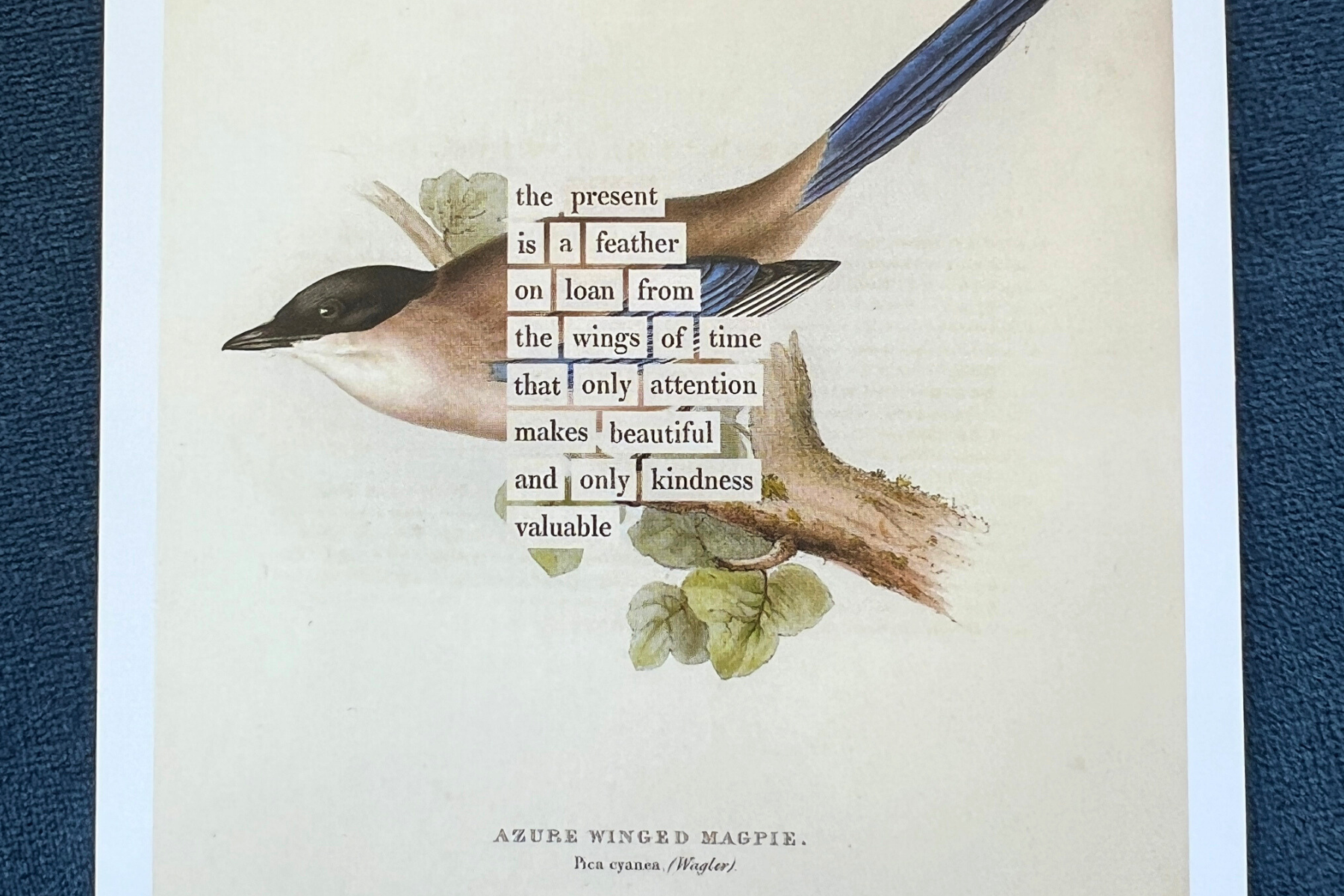
Image: A photo from Maria Popova’s Almanac of Birds (Divinations for Uncertain Days), inviting a moment of attention to the present | From Tiffany Vora’s personal collection
In both biological and artificial systems, intelligence may emerge less from raw capability than from how differences are detected, shared, and resolved. Perhaps consciousness plays a role here, as well (including in nonhuman species).
Some neuroscientists suggest that conscious awareness may arise where signals from many subsystems are brought together and reconciled into a coherent narrative about what is happening. (Be aware: this is a raging debate.) If that’s indeed the case, then consciousness itself might live at the same boundary where intelligence emerges: the place where competing interpretations of the world are compared and integrated. I’ll leave discussion about the possibility of artificial consciousness for you to have over dinner tonight!
All of this musing circles me back to my morning walk.
The podcast hadn’t changed. My routine hadn’t changed. The baseline was the same as always.
But today, for reasons I can’t fully explain, I became conscious of the diffs.
And sometimes that’s all it takes for the world to become interesting again.
About Tiffany

Dr. Tiffany Vora speaks, writes, and advises on how to harness technology to build the best possible future(s). She is an expert in biotech, health, & innovation.
For a full list of topics and collaboration opportunities, visit Tiffany’s Work Together webpage.
Get bio-inspiration and future-focused insights straight to your inbox by subscribing to her newsletter, Be Voracious. And be sure to follow Tiffany on LinkedIn, Instagram, Youtube, and X for conversations on building a better future.
For the Curious and the Voracious
Subscribe to Be Voracious, Tiffany’s newsletter, for thoughtful conversations on science, innovation, and leadership, delivered straight to your inbox.

Buy Tiffany a Cup of Coffee | Image credits: Irene Kredenets via Unsplash.
Donate = Impact
If this article sparked curiosity, inspired reflection, or made you smile, consider buying Tiffany a cup of coffee!
Your support will:
Spread your positive impact around the world
Empower Tiffany to protect time for impact-focused projects
Support her travel for pro bono events with students & nonprofits
Purchase carbon offsets for her travel
Create a legacy of sustainability with like-minded changemakers!
Join Tiffany on her mission by contributing through her Buy Me a Coffee page.