Want to Feed Mars? Start with Hot Water
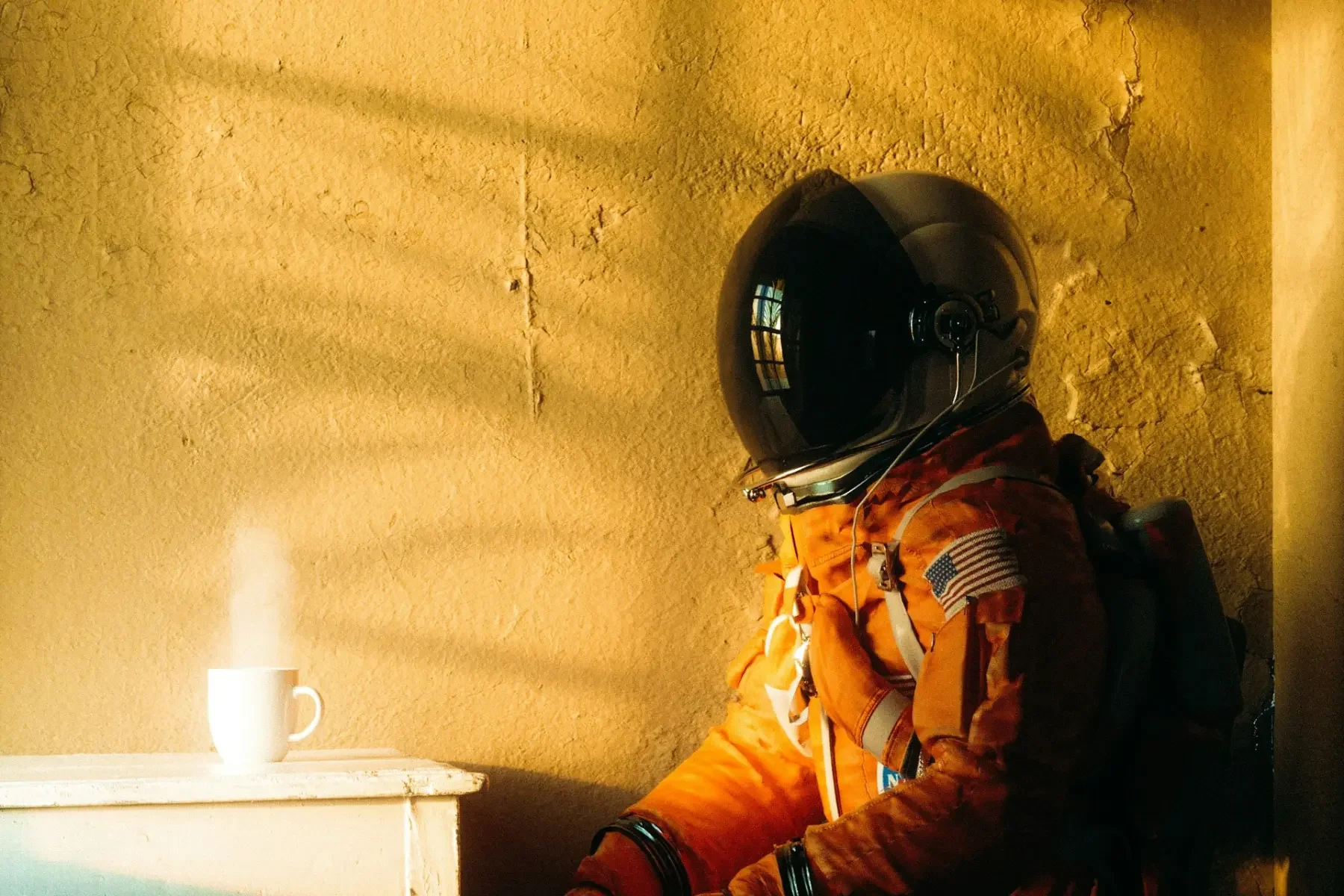
Image credits: Cash Macanaya | Unsplash
“Hot water is non-negotiable.”
That was Dr. Grace Douglas’s final insight during a panel I moderated at the Explore Mars 2026 Humans to the Moon and Mars Summit about innovating for food in space. (You can watch the full panel video here.)
Not synthetic biology. Not hydroponic farms stretching beneath the Martian regolith. Not a Star Trek replicator.
Hot water.
Innovating for Food Futures in Space Begin with Constraints
I think this tells us something important about how innovation actually happens. When we imagine feeding humans on the Moon or Mars, it’s easy to leap to the exciting stuff: crops grown in space, precision fermentation, bioreactors turning waste streams into food.
Grace, who leads food research at NASA Johnson Space Center, started our conversation somewhere much closer to the ground. It turns out that the food system on the International Space Station is actually pretty good. Astronauts have a large menu, regular resupply, hot and ambient metered water, a food warmer, and even a small chiller.
The farther we go from Earth, the tighter the constraints become, particularly for mass, power, and volume. That seems obvious, doesn’t it? That creates a striking mismatch between the food futures we like to imagine and the capabilities we’re actually going to have (at least at the beginning).
For example, the Orion crew vehicle that was used for Artemis II doesn’t have hot water. It doesn’t even have metered water of the sort available on the ISS. Fast forward to the day that humans return to the Moon: astronauts working on the lunar surface may have only brief periods between EVAs to prepare and eat meals.
So one of the breakthrough technologies for the future of human exploration might be…a radically better way to heat water.
Rethinking Breakthrough Technologies for Long-term Space Missions
Image credits: Dr. Ina Melni | Unsplash
Here are a few more breakthrough technologies that we’re really going to need for human exploration of space:
Refrigeration that requires a fraction of today’s mass and power
Food that remains nutritious, safe, familiar, and delicious for five years
Packaging that protects that food without eventually creating a landfill on Mars
Real-time pathogen detection that lets astronauts know whether food is safe without a microbiology lab, abundant water, or conventional chemical sanitation.
These aren’t particularly glamorous problems. They may, however, be civilization-enabling ones.
That distinction was very much on my mind because two days before this panel, Explore Mars had convened scientists, engineers, entrepreneurs, students, and innovators for an eight-hour workshop on food innovation for Mars. (You can read more about that workshop here, and explore deep dives from previous Mars Innovation Workshops here.) We deliberately tried to resist a common innovation trap: starting with the technology. Instead, we repeatedly asked, “What are the underlying problems that actually have to be solved?”
I put a version of that question to the panelists, too:
If I gave you a magic wand and you could solve one underlying food-system problem—not invent a technology, but eliminate a problem—what would you choose?
Their answers were revealing.
What Do We Need to Solve Before We Can Feed Mars?
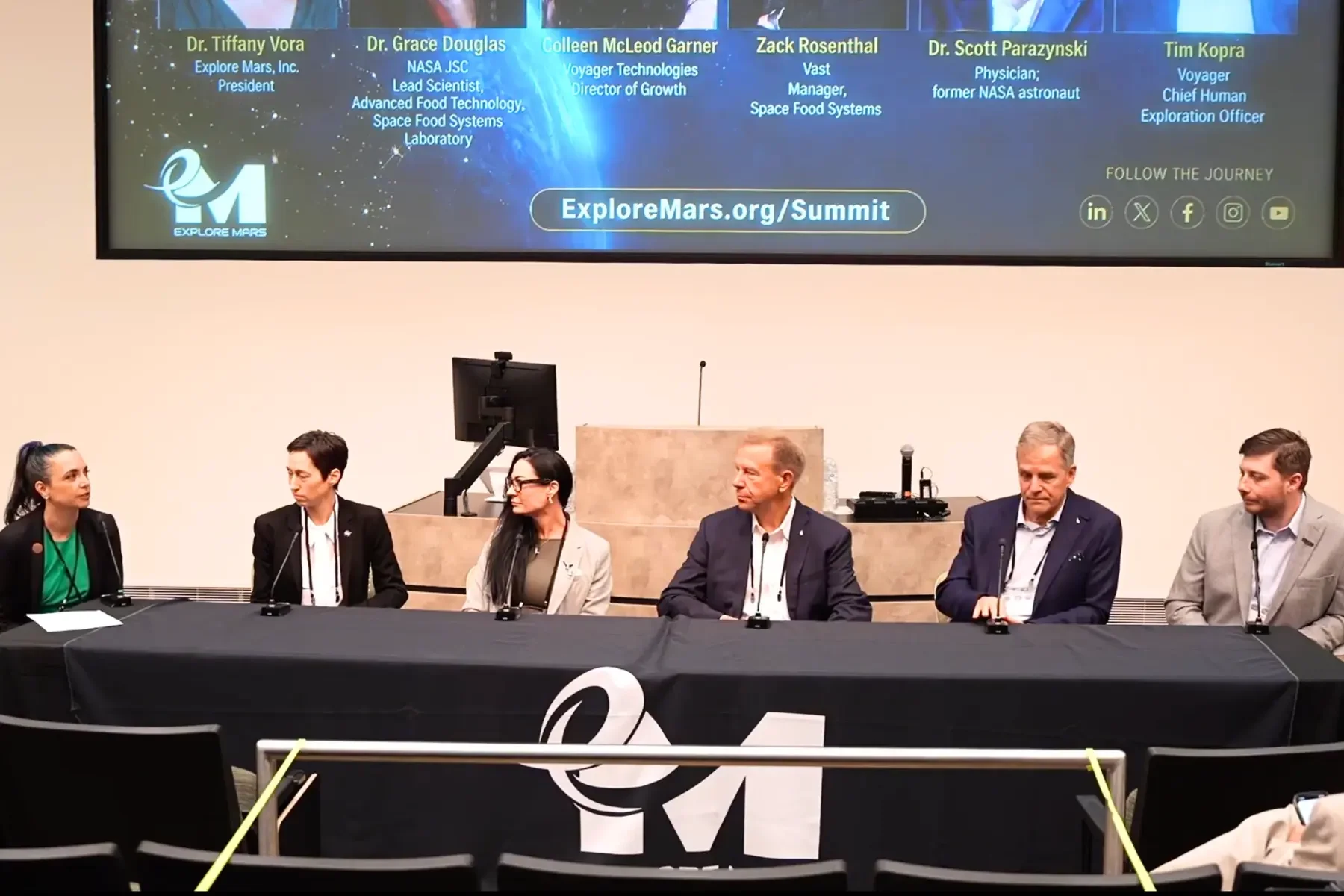
The Innovating for Food in Space panel at the 2026 Humans to the Moon and Mars (H2M2) Summit.
Grace chose shelf life. Today’s system provides roughly three years. “We really need five years for Mars,” she said. This isn’t just a matter of better packaging; refrigeration, substrates, nutrition, food quality, mass, volume, and power are all entangled in the problem.
Former astronauts Dr. Scott Parazynski and Tim Kopra both went straight to waste and circularity. “We don’t want to create a landfill on the Moon or Mars,” Scott said. Tim agreed: “We gotta figure out a way to minimize the trash and then be able to reuse that.”
It’s a wonderfully concrete illustration of what changes when you design for another world. On Earth, throwing something “away” can disguise the fact that it still exists somewhere. On Mars, there really is no “away”.
Then Zack Rosenthal of Vast pointed to something I definitely hadn’t thought enough about: ingredients. “Look in your pantry at home,” he told us. We’ll find flour. Grains. Sugars. Stabilizers. Emulsifiers. Earth’s food system rests on an enormous industrial ecosystem that turns biological raw materials into ingredients, and ingredients into cuisine. If someday we want people on Mars to make food rather than simply unpack it, growing tomatoes or producing microbial biomass is only part of the challenge. As Zack put it, “You have to develop that base capability to generate these ingredients.”
We need the full capability stack between biology and dinner.
Now of course, food isn’t just fuel. Scott and Tim both described meals as an important part of life in orbit. After days filled with spacewalks, robotics, maintenance and tightly scheduled work, dinner could be the moment when the crew came together. Scott remembered “music playing in the background and just everybody kind of beginning to relax,” often while sharing foods from the different cultures represented aboard the station.
Zack made another observation I loved: food can be one of the few areas in an astronaut’s highly regimented day where they retain some control—“what they’re eating, when they’re eating it, and how they’re eating it.” That agency matters.
Colleen McLeod Garner of Voyager Technologies pushes this idea further through her work in neurogastronomy. Smell and taste connect us not merely to pleasure, but to memory, identity, people and places. During the food innovation workshop, Colleen led us through an exercise involving smells that might tether an astronaut to Earth: soil, clean laundry, familiar foods.
She described the goal beautifully as maintaining “normalcy in the extraordinary.” I knew exactly what she meant. During my Mars analog missions, I found I could imagine living without the wind on my face. But the idea of never smelling freshly cut grass again was unexpectedly difficult.
Now imagine children born on Mars, perhaps spending much of their lives underground because the surface environment is so hostile to human biology. What does “home” smell like to them?
Every Space Problem Is Also an Earth Problem
This is where a conversation about calories, packaging and shelf life becomes a conversation about something much bigger. We’re not trying merely to keep human organisms metabolically functional beyond Earth. We’re trying to figure out how humans might thrive there.
How they gather. How they celebrate. How they retain agency. How they create culture. How dinner after a hard day’s work still feels like dinner. These should sound familiar. Why? Because every one of these space problems is also an Earth problem.
Mars doesn’t create these problems. But Mars does strip away many of the workarounds we rely on here on Earth and forces us to ask what a food system looks like when waste, energy, water, mass, and human attention all have hard limits.
Solve those problems for Mars, and we build a better food system for Earth along the way.
Near the end of our conversation, Zack offered another great insight: “The future of space is not being built by people 10 years from now. It’s being built by us right now.”
So perhaps the most useful question about the future of food is: What problems would we have to solve to make feeding people on Mars almost ordinary?
Let’s start there.
With hot water for all.
If this conversation sparked your curiosity, you might want to explore these additional resources:
💡 Mars Innovation Series, Deep Dive 1: The Future of the Space Economy: Profit, Purpose, and the Path to Sustainability | Read the first Mars Innovation Series Deep Dive (and check out the rest of the deep dives too!)
💡Exploring What a Green Mars Could Mean, For Mars and Earth | Read my reflection piece here
💡Can You Retire on Mars? | Read my reflection piece here
💡Book Recommendation: Becoming Martian by Dr. Scott Solomon | Read my book review here
💡Why I Talk About Chocolate (And What It Has to Do with the Future)| Read my article here
💡Space Food Gets a Biotech Upgrade | Watch the Exponential Africa podcast clip here
💡So… Why Space? | Watch the H2M2 video clip here
💡What Will Life on Mars Look Like? | Watch the H2M2 video clip here
About Tiffany

Dr. Tiffany Vora speaks, writes, and advises on how to harness technology to build the best possible future(s). She is an expert in biotech, health, & innovation.
For a full list of topics and collaboration opportunities, visit Tiffany’s Work Together webpage.
Get bio-inspiration and future-focused insights straight to your inbox by subscribing to her newsletter, Be Voracious. And be sure to follow Tiffany on LinkedIn, Instagram, Youtube, and X for conversations on building a better future.
For the Curious and the Voracious
Subscribe to Be Voracious, Tiffany’s newsletter, for thoughtful conversations on science, innovation, and leadership, delivered straight to your inbox.

Buy Tiffany a Cup of Coffee | Image credits: Irene Kredenets via Unsplash.
Donate = Impact
If this article sparked curiosity, inspired reflection, or made you smile, consider buying Tiffany a cup of coffee!
Your support will:
Spread your positive impact around the world
Empower Tiffany to protect time for impact-focused projects
Support her travel for pro bono events with students & nonprofits
Purchase carbon offsets for her travel
Create a legacy of sustainability with like-minded changemakers!
Join Tiffany on her mission by contributing through her Buy Me a Coffee page.
Our Editorial Process
We believe AI is most valuable when it strengthens human thinking rather than replaces it. Throughout our editorial workflow, we use AI to transcribe conversations, organize information, brainstorm, challenge assumptions, improve clarity, automate repetitive tasks, and pressure-test our reasoning before publishing.
Editorial responsibility remains ours. AI helps us think, write, and work more effectively, but judgment, accountability, and our relationship with readers remain human.