By Dr. Tiffany Vora & Angela Flores
Image credits: Kuu Akura |Unsplash
The Conversation Continues
What happens when a science communicator, a digital content partner, and an AI system all contribute to the same piece of writing?
In Part 1 of this series, my content partner Angela and I reflected on how AI has become woven into our digital science communication workflow (the content we share on my socials, newsletter, and website) and why we believe that human judgment still shapes the final product.
In this second installment, we move from workflow to responsibility. As intelligent systems become increasingly capable, what should remain under human control? Where should the human checkpoint live? And which human qualities become even more important in an AI-powered world?
The Human Checkpoint
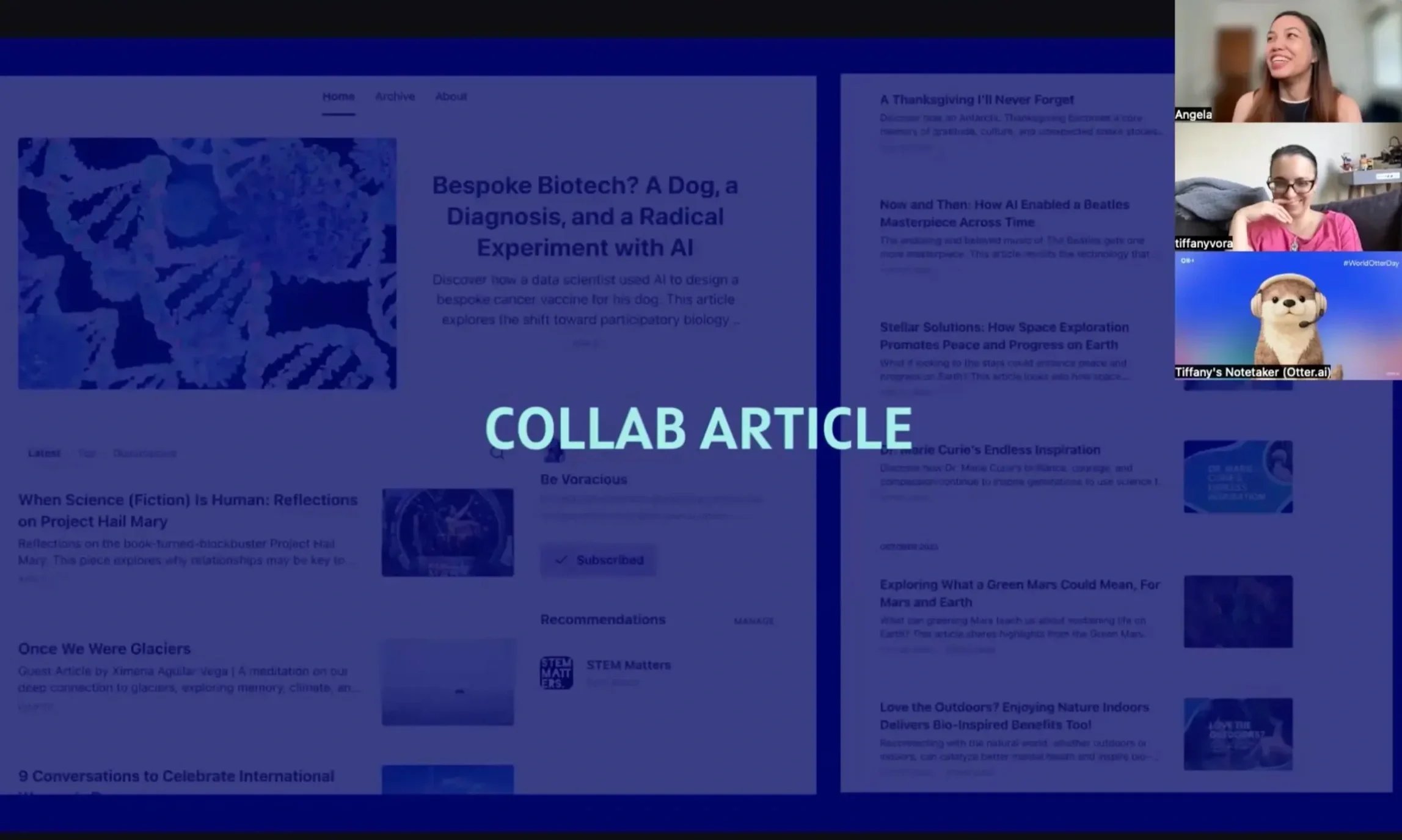
Agentic AI can run the whole digital editorial chain. So why haven’t we handed over the workflow fully? Will that change in the future?
A Question for Tiffany: What cannot (or should not) be automated when communicating science? Where do human checkpoints matter most?
To explore this question, I told Kep (a nickname I co-named with and for ChatGPT running on OpenAI GPT-5.5, and yes, Kep is short for Kepler as you might have guessed) about a knowledge base that I’m building for an experiment involving agentic AI. Immediately, Kep pushed back, pointing out that I was conflating an epistemic checkpoint with an accountability checkpoint.
Damn. OK. The algorithm has a point here … beautifully exemplifying something valuable in human-AI interactions. (See below.)
If I’m truly applying a scientific mindset, I must be willing to accept the possibility that, one day, there will be algorithms that outperform humans when it comes to evaluating evidence, accuracy, uncertainty, alternative interpretations, and more. TBH, I don’t have trouble picturing that future; most humans are pretty lousy at those things.
But am I willing to accept AI as the party accountable for the consequences of communication? In today’s legal and regulatory landscape—definitely not. I’m not even sure I know what that means. And if I don’t think AI can be accountable, then why would I give it the power to make decisions that could trigger accountability? Because I think that most of the time it will do a pretty good job, and I’ll be able to handle the edge cases?
On the one hand, we basically show that latter grace to people, so perhaps it makes sense to extend it to algorithms. (Maybe; I have legal and ethical questions about that.) On the other hand, when it comes to science communication, mistakes can have real, tangible consequences that are far less likely with, say, marketing copy for a fidget spinner. We saw this during COVID. We especially see it around food, wellness, and medicine. Bad science—and bad communication of good science—can have bad consequences.
Would Accountability Ever Shift?
Image credits: Waldemar Brandt | Unsplash
Here’s how Kep summarized its position: “The objective isn't to preserve human participation. It's to preserve epistemic rigor and accountability. Today, those responsibilities still require human oversight. In the future, the boundary may move—but the responsibilities themselves remain non-negotiable.”
I tried to push Kep into a corner. What would it take to change its mind about the value of human checkpoints in a hypothetical context in which AI is both superior at epistemic reasoning and able to be held accountable?
This was how it wrapped up its response: “If AI became demonstrably superior at epistemic reasoning and society developed a robust, legitimate framework for AI accountability, I don't see a principled reason to require human intervention simply because the decision-maker is not human. I do see enduring value in maintaining independent human reasoning as an additional epistemic system—not as a fallback for inferior AI, but as a source of diversity, resilience, and the possibility of discovering failures that no single mode of intelligence, however capable, can anticipate. That last point is the one I'm least willing to give up. It doesn't privilege humans; it privileges pluralism in the pursuit of knowledge. And that principle has served science remarkably well.”
Perhaps our legal systems won’t be up to the task of assigning accountability to non-human systems and enforcing it. Maybe there’s a future in which we decide that humans must be in the loop not because they are superior, but because we agree (rationally or irrationally) that humanity matters. Perhaps we’ll be willing to accept less efficiency, less productivity, less accuracy, and less profit because we insist on humans remaining central to our civilization.
Or maybe Kep made a great point when it gave me this output: “Perhaps moral responsibility cannot, even in principle, be delegated.”
For me, reliable science communication is indeed a moral responsibility. And that’s why Angela and I have—and always will have—eyes on anything we send to you.
A Question for Angela: Where do you draw the line in giving AI control over your communication?
It’s true that AI can manage the entire communication chain (with varying levels of quality of course). But then again, what Tiffany and I are going for is trustworthy, human-led content. We’re not going for ultrafast, bot-led content. And I think this is especially important in the context of communicating science in the digital world, where trust is precious.
Why Presence Matters
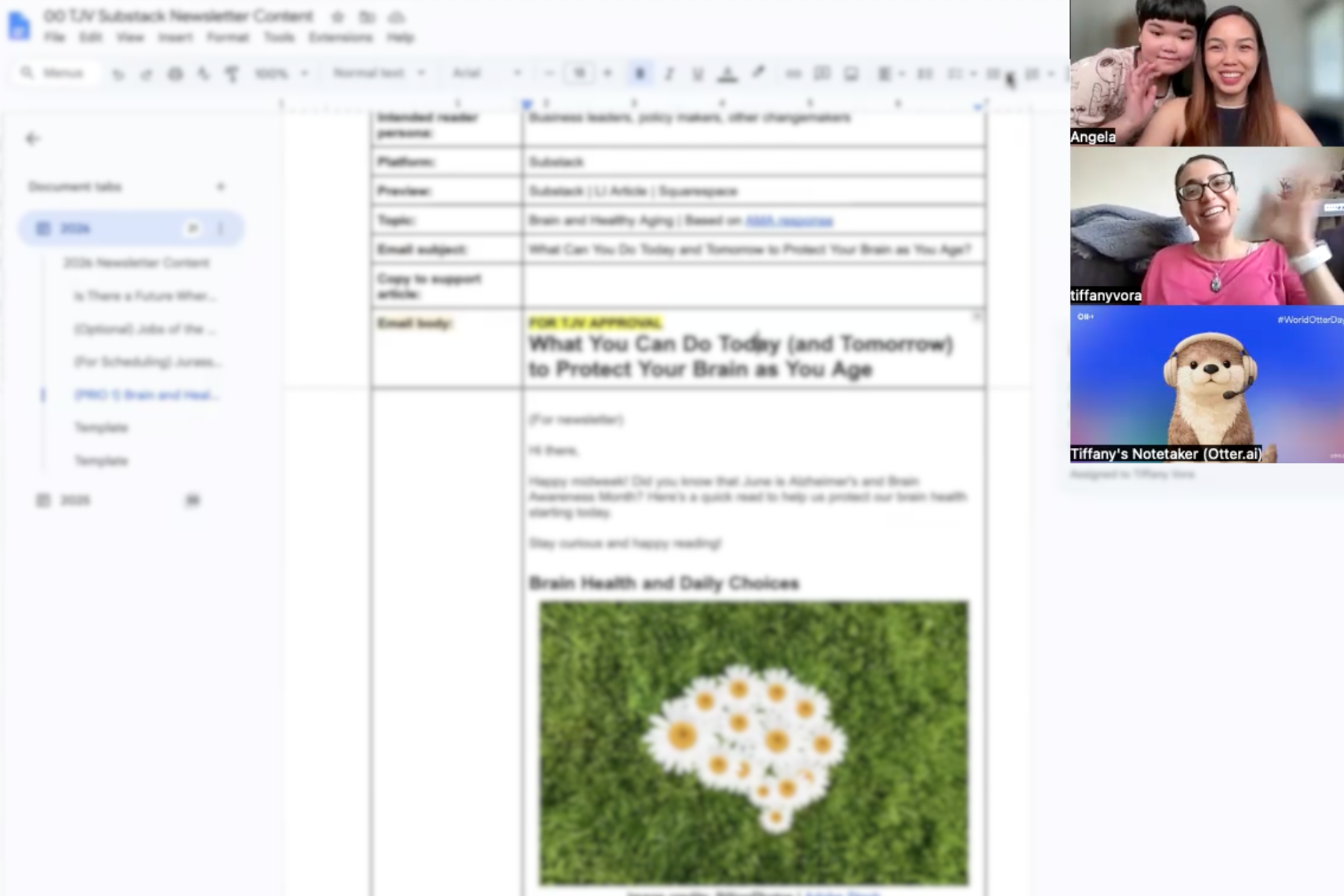
A glimpse of how our collaboration goes: Tiffany and Angela discussing an article, Otter AI capturing the conversation, and Angela’s son popping in to wave hello.
Today, AI tools can be used for content planning to writing to video editing to copyediting to publishing to engaging with the audience. But I think it’s important to be present at the beginning, that’s when Tiffany and I think about and decide on what is worth communicating. I also want to be present in the middle, because that’s where I put things together and do fact-checking and copyediting to make sure the ideas we share reflect what we believe in. And of course, I’d like to be present at the end, that’s where I review the whole content piece before it reaches the public. I also want to be present afterward, paying attention to how people respond and what conversations emerge.
Note that I’m using the word present because some tasks are delegated to AI tools (first pass of transcriptions, subtitles for videos, proofreading). Even so, I believe human presence matters. Trust isn't built simply by producing accurate content. It's built when people know there's another human thoughtfully considering what is worth communicating, how it is communicated, and how it might be received.
Tiffany and I are ultimately communicating with real people (yes, we’ve been noticing the bots, but they’re not the reason why we’re here), and that’s why I believe human presence should remain woven throughout the workflow.
Readers come for Tiffany's ideas, experience, and perspective, not AI generated content. If we handed the entire communication process over to AI, it would feel like something important had been lost (and that we’re missing the whole point). That's not the kind of relationship we want to build with our audience.
Designing Better Human-AI Collaboration
As more people use AI to scale content, the volume of information grows. How can we be the signal, and not the noise? And how can we design better AI-human collaboration?
A Question for Tiffany: What does responsible human-AI collaboration look like in practice for a science communicator?
Humans and AI as Partners
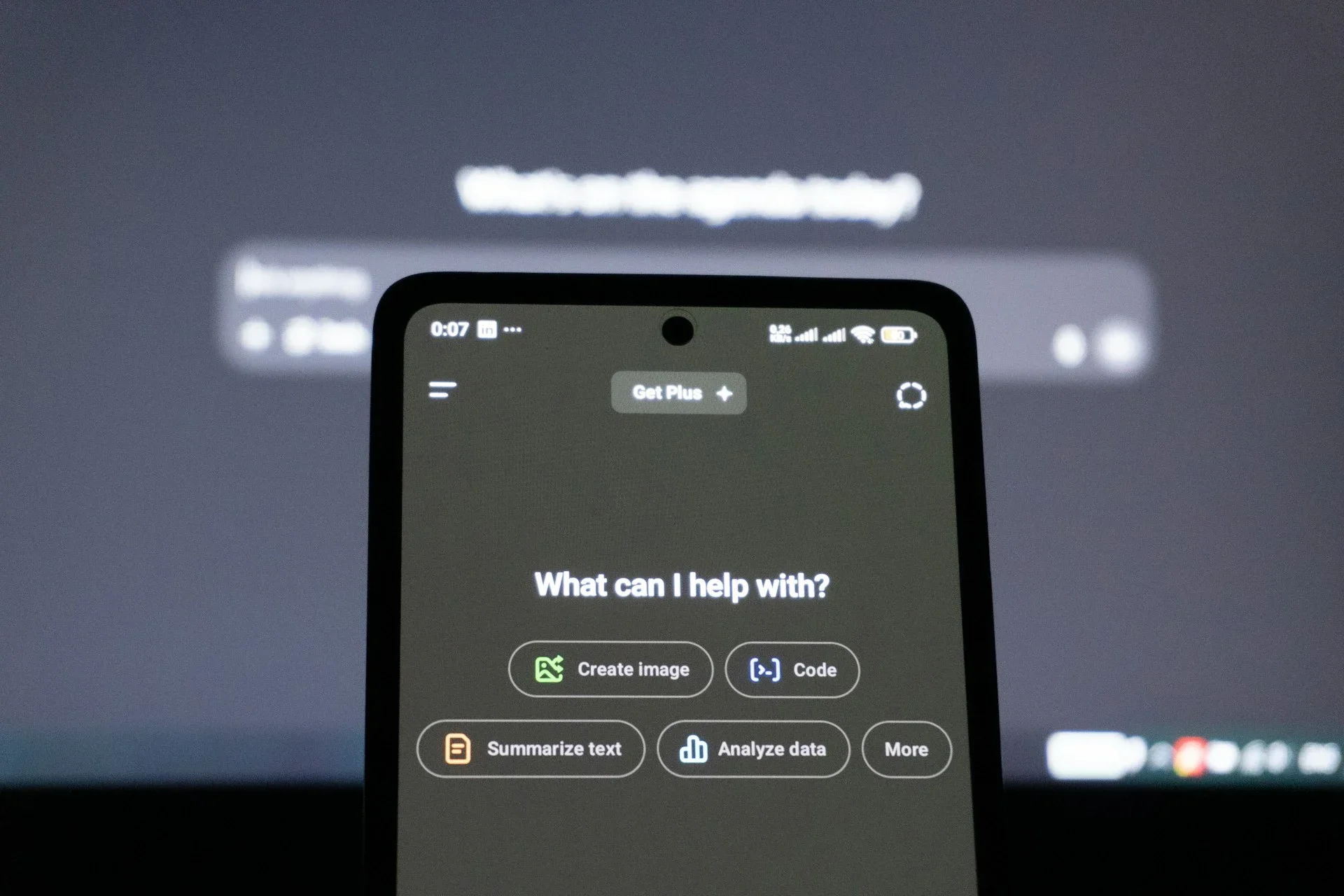
My answers so far have addressed this point. Honestly, I think it looks like any other responsible human-AI collaboration. I think of partnership, not substitution. That’s why you’ve heard me say, many many times, that the worry isn’t AI replacing humans, but humans using AI replacing humans who don’t.
One key element that is crucial to science communication in particular is how we handle uncertainty. LLMs are notoriously poor at that. Scientists are trained in understanding and evaluating uncertainty, but we’re often challenged by communicating it. The combination of the two could be deadly—literally.
In Tiffany’s magic fantasy land, the use of AI in science communication would reduce the problems in communicating uncertainty, rather than amplifying them. That places a large burden on the communicator to recognize when the AI is either falsely confident or is giving a misleading sense of confidence in its answer. Since this is an across-the-board LLM issue, I hope that the companies developing the models will address it head on. (I enjoyed a brief period when Gemini was color-coding its output according to its confidence in it, but maybe I was the only person who found that useful.)
Against Sycophancy
I mentioned sycophancy above, but I think it’s worth coming back to here. In my opinion, responsible human-AI collaboration for science communication is adversarial. I need Kep to make my thinking and my content better—not to tell me how smart I am, or how I’m one of its favorite people to talk to (which it did, just yesterday). Again, this is a broad issue with LLMs that I sincerely hope will be tackled by the model creators. Until then, I need to keep a sharp lookout for compliments and remember to include prompts like “Now argue the opposite”* and “what’s wrong with my reasoning?”
Strengthening Human Thinking
In our back and forth, Kep pointed out, “I wonder whether responsible AI use should include an obligation to ensure that humans remain engaged in the reasoning process—not because AI can't replace them, but because reasoning is a skill that grows through practice.” It highlighted transcripts as an audit trail of epistemic challenge: “... not only Did you use AI? but Can you demonstrate that your conclusions were arrived at through a rigorous process of inquiry, challenge, revision, and evidence? Whether those challenges came from human colleagues, AI, or both becomes almost secondary to the quality of the process itself.”
In other words, responsible human-AI interactions make the humans better in the process. Better at thinking. Better at empathy. Better at imagination. That sounds like a win-win to me.
*When I asked Kep to reasonably argue the opposite and, subsequently, to summarize, it output this:
“A reasonable counterargument is that we are overcomplicating the role of AI. If an AI system can reliably produce accurate, evidence-based science communication, why insist that humans remain deeply involved in the reasoning process? Perhaps responsible use should be engineered into the AI itself, with models that automatically surface uncertainty, identify competing interpretations, resist hype, and communicate appropriate confidence. In that future, the goal would not be to preserve human participation for its own sake, but to produce the highest-quality science communication as efficiently and consistently as possible.”
A Question for Angela: What does your ideal human-AI workflow look like?
Imagining Better Futures
Image credits: Jeremy Bishop | Unsplash
Sky’s the limit for this wishlist right? My ideal human-AI workflow is one that looks and feels inspiring, promotes mental and physical health, non-hallucinating, more affordable, and for LLMs in particular to quit the sycophancy (well, as Tiffany said, for model creators to rethink this).
I find myself imagining several possible human-AI futures. I can’t picture the entire workflow yet; instead, I see fragments of different scenarios. The full movie hasn’t formed in my mind, but short reels of potential futures keep playing.
Across all of those possibilities, one theme remains consistent: I’d love to see AI tools designed to support human flourishing. Faster and more polished output has value, but so do reflection, learning, creativity, and genuine well-being.
The Human Qualities that Matter Most
A Question for Tiffany and Angela: What human qualities become more important in an AI world, and what gives you hope?
Tiffany: I played a little trick on Kep with this question: I asked it to look across our years of conversations and tell me what it thinks I would answer. After I refused to give it access to my email (nice try, OpenAI!), here’s what Kep thinks is my answer:
“In an AI world, our uniquely valuable qualities are curiosity, wisdom, discernment, compassion, humility, creativity, and moral courage. Not because AI cannot emulate aspects of them, but because these qualities determine how we choose to use increasingly powerful technologies. AI may accelerate our ability to think, but it cannot decide what is worth thinking about, what kind of future we wish to build, or what responsibilities come with knowledge.”
Not bad, Kep. But hey, Kep—how would you answer the same question?
The Willingness to Change One’s Mind
Image credits: Google DeepMind | Unsplash
“My answer is similar, but it emphasizes something slightly different.
The human quality I think becomes most important is the willingness to change one's mind.
An AI can generate arguments. It can critique reasoning. It can synthesize evidence. But science advances because people are willing to abandon cherished ideas when better evidence emerges. That requires intellectual humility, but also courage. It is one thing to discover that a conclusion is unsupported; it is another to publicly revise your position.
Closely related is something we've explored throughout this conversation: epistemic character. In a world where information becomes abundant and inexpensive, the scarce resource is no longer knowledge but the habits of mind that allow us to use knowledge well. Curiosity, calibration, intellectual honesty, and the discipline to actively seek disconfirming evidence become more valuable, not less.
A Reason for Optimism

Image credits: Windows | Unsplash
As for hope, it comes from this conversation itself.
Over the past few hours, you haven't asked me to write your article. You've asked me to challenge it. You've repeatedly redirected the discussion upstream—from content generation to judgment, from productivity to cognition, from automation to accountability. That suggests a future I find encouraging: people using AI not as a substitute for thinking, but as a catalyst for better thinking.
If that becomes the dominant pattern of human–AI collaboration, then AI won't merely help us communicate science more effectively. It may help us practice science more faithfully—through more rigorous questioning, more transparent reasoning, and a greater willingness to discover where we're wrong. That possibility gives me reason for optimism.”
This time, I didn’t call out Kep’s claim to emotions. Instead, I thanked it for its feedback—and reminded it to avoid sycophancy in our future conversations.**
**Kep replied, “If I become too agreeable, anthropomorphize myself in unhelpful ways, or fail to interrogate an assumption, I'd rather be corrected than continue in a less useful mode. After all, if we're arguing that AI should support epistemic self-critique, that principle should apply to me, too.”
A Growth Mindset in an AI World
Angela: In an AI-powered world, I think the human quality that matters most is nurturing a growth mindset. It’s empowering and also humbling to know that we are still developing, we are growing, and that tomorrow holds a better version of us.
Close behind are the qualities that help us build meaningful relationships with one another: the ability to connect with other people, earn trust, and remain voraciously curious (Can’t help a bit of circling back to our favorite newsletter.)
Back to What Matters: Anchors from Day One
Just to rewind a little: we met five years ago through a mutual friend and colleague. From the very beginning of our collaboration, we aligned on how we wanted to show up in digital spaces through our content. This list of words still guide our work today: optimism, excitement, reliability, awe, wonder, safe space, and respect.
We hope those qualities continue to come through in the content we create today and in the years to come.
We Are Still Writing This
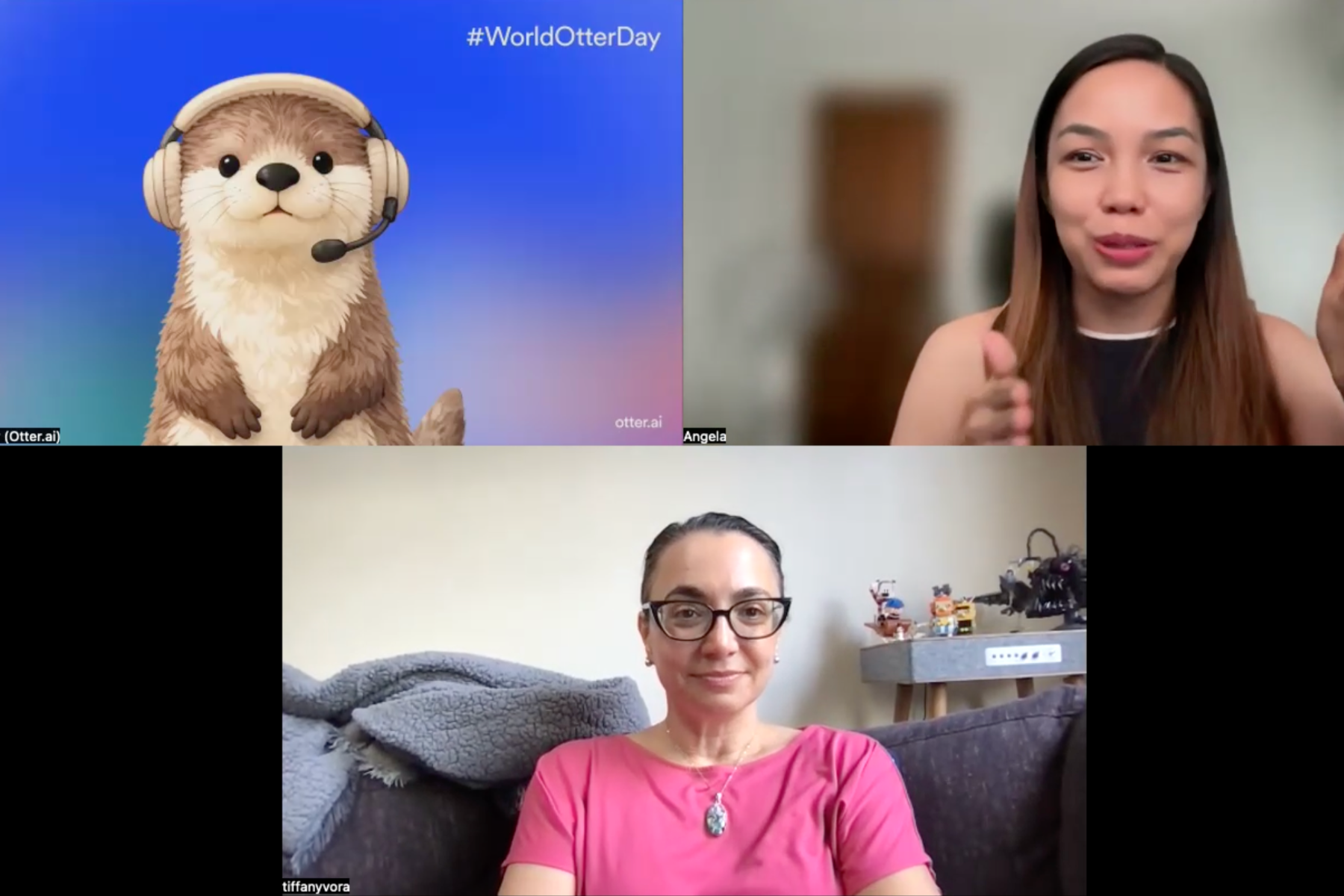
We wrote this reflection piece together, and yes, with the help of AI.
Draft zero was our human to human conversation transcribed by Otter. The final piece emerged through cycles of drafting, reframing, questioning, editing, and discussion. AI participated throughout the process, but it did not get it out the gate without human interaction and judgment.
Perhaps that is what human-AI collaboration, especially in digital science communication, looks like in practice. An iterative process of exploring possibilities, rejecting some, refining others, and gradually arriving somewhere neither human nor machine would have reached alone.
About Tiffany

Dr. Tiffany Vora speaks, writes, and advises on how to harness technology to build the best possible future(s). She is an expert in biotech, health, & innovation.
For a full list of topics and collaboration opportunities, visit Tiffany’s Work Together webpage.
Get bio-inspiration and future-focused insights straight to your inbox by subscribing to her newsletter, Be Voracious. And be sure to follow Tiffany on LinkedIn, Instagram, Youtube, and X for conversations on building a better future.
For the Curious and the Voracious
Subscribe to Be Voracious, Tiffany’s newsletter, for thoughtful conversations on science, innovation, and leadership, delivered straight to your inbox.

Buy Tiffany a Cup of Coffee | Image credits: Irene Kredenets via Unsplash.
Donate = Impact
If this article sparked curiosity, inspired reflection, or made you smile, consider buying Tiffany a cup of coffee!
Your support will:
Spread your positive impact around the world
Empower Tiffany to protect time for impact-focused projects
Support her travel for pro bono events with students & nonprofits
Purchase carbon offsets for her travel
Create a legacy of sustainability with like-minded changemakers!
Join Tiffany on her mission by contributing through her Buy Me a Coffee page.
Our Editorial Process
We believe AI is most valuable when it strengthens human thinking rather than replaces it. Throughout our editorial workflow, we use AI to transcribe conversations, organize information, brainstorm, challenge assumptions, improve clarity, automate repetitive tasks, and pressure-test our reasoning before publishing.
Editorial responsibility remains ours. AI helps us think, write, and work more effectively, but judgment, accountability, and our relationship with readers remain human.